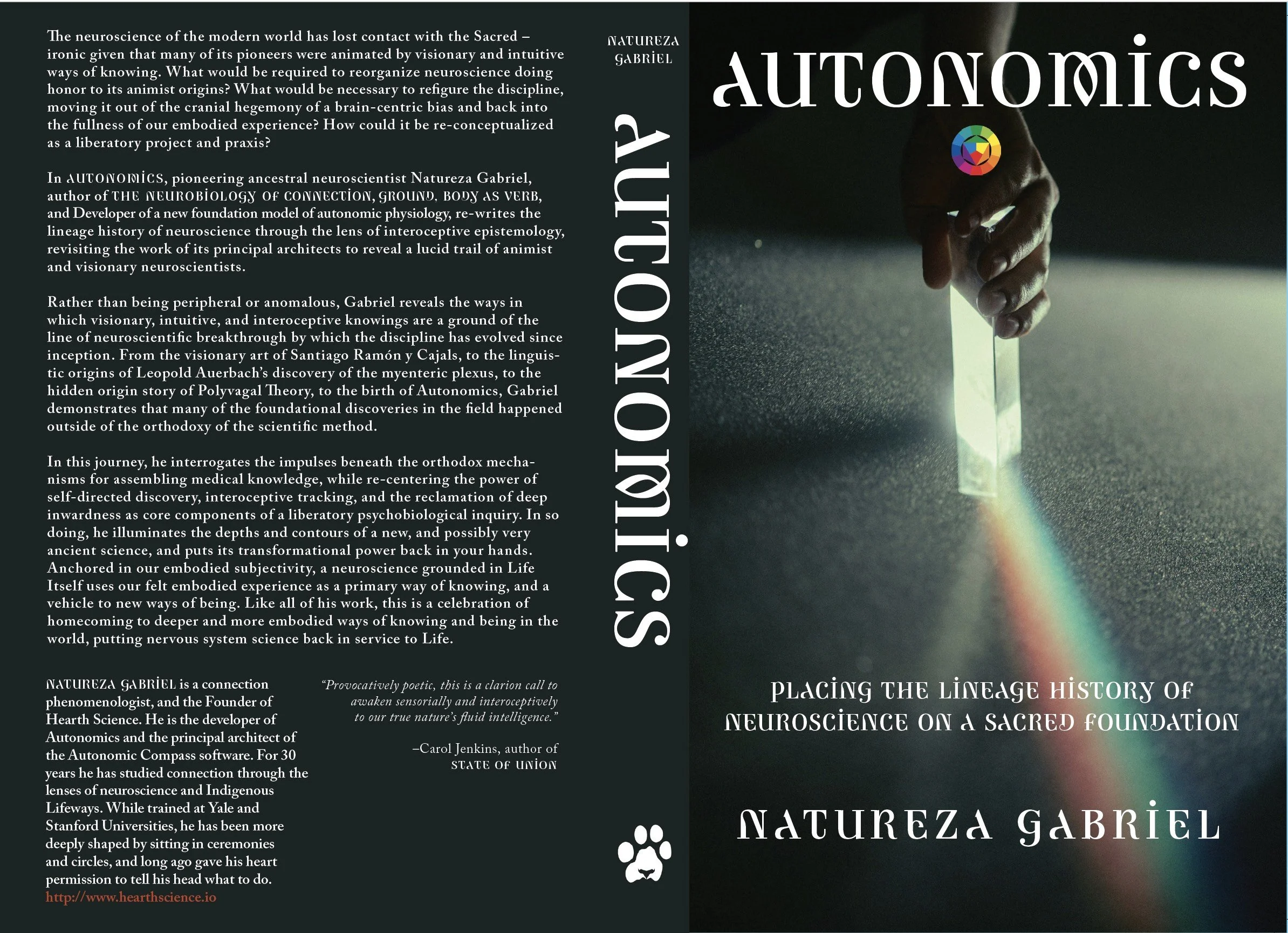
AUTONOMICS: PLACING THE LINEAGE HISTORY OF NEUROSCIENCE ON A SACRED FOUNDATION
“Provocatively poetic, this is a clarion call to awaken sensorially and interoceptively to our true nature’s fluid intelligence.”
A brief conversation with Gabriel about Autonomics

Why did you write this book?
I started writing Autonomics shortly after publishing The Neurobiology of Connection in November of 2024. I had worked towards being able to write TNOC for about 15 years. I knew it was groundbreaking work.
I was alarmed and saddened by a certain amount of backlash directed at me personally from the Polyvagal community, who felt that our work in autonomic physiology was discrediting, attacking, or undermining Polyvagal Theory. The book began as an attempt to frame transformations in paradigms in neuroscience as productive frictions, à la Thomas Kuhn’s formulation from The Structure of Scientific Revolution.
I was having a hard time understanding why the Polyvagal community was not extremely excited about our work, because we had resolved some of the obvious limitations of the theory in deeply elegant ways. The reason we were able to do this was because we were applying Polyvagal Theory as rigorously as any group in the world. This was, therefore, not an attack on it, but a form of respect that compelled us to move it further forward. And this seeing was also surfacing, with greater clarity, significant holes in the foundation of modern neuroscience.
Two things happened fairly quickly as I began to work with the ideas in the book. One of them was that I began to think of the origin story of Polyvagal Theory through the lens of the story Stephen Porges had told me about its more private and personal origins in his own experience the second time I interviewed him at length. The other was that as I continued to study the lineage history of neuroscience I kept encountering origin stories that were deeply personal and undermined our received narration about how innovations in the field happened.
We are told that innovation happens in science empirically. But that is not what the actual lineage history of neuroscience shows. What the history shows is that innovators have an intuition or revelation, and then seek the evidence that supports it. This flips the notion of the process of discovery on its head and significantly complicates our understanding of where ‘validated’ medical knowledge originates.
When the Paul Grossman critique re-united the public debate about Polyvagal Theory in 2026, one of the things that struck me was the distance between mechanism (source nucleii of a brainstem neural circuit) and meaning. We get super hung up on mechanism, but what matters more at a practical level is meaning.
It also became clear to me that scientific jockeying back-and-forth about esoteric inferences happens in a domain that is both connected to and remote from the experiential intimacy of our felt experience.
I would propose Stephen Porges intuited the ‘social engagement system’ because he felt it, and then sought out a plausible evolutionary mechanism for it. Paul Grossman is refuting it because he cannot feel it, and he is seeking out established inference that refutes it. Both views are partial.
This book is for anyone who is grappling with how we make meaning in science, how we know what we know, and with the notion of what constitutes a ‘valid’ claim on knowledge. It is for anyone interested in the history of neuroscience.
Anything else you’d like to tell us about the book?
The book had six different working titles, including Visionary Neuroscience, and Phenomenology of an Embodied Neuroscience, before I settled on the current one. Many of the illustrations are in the form of woodblock prints.